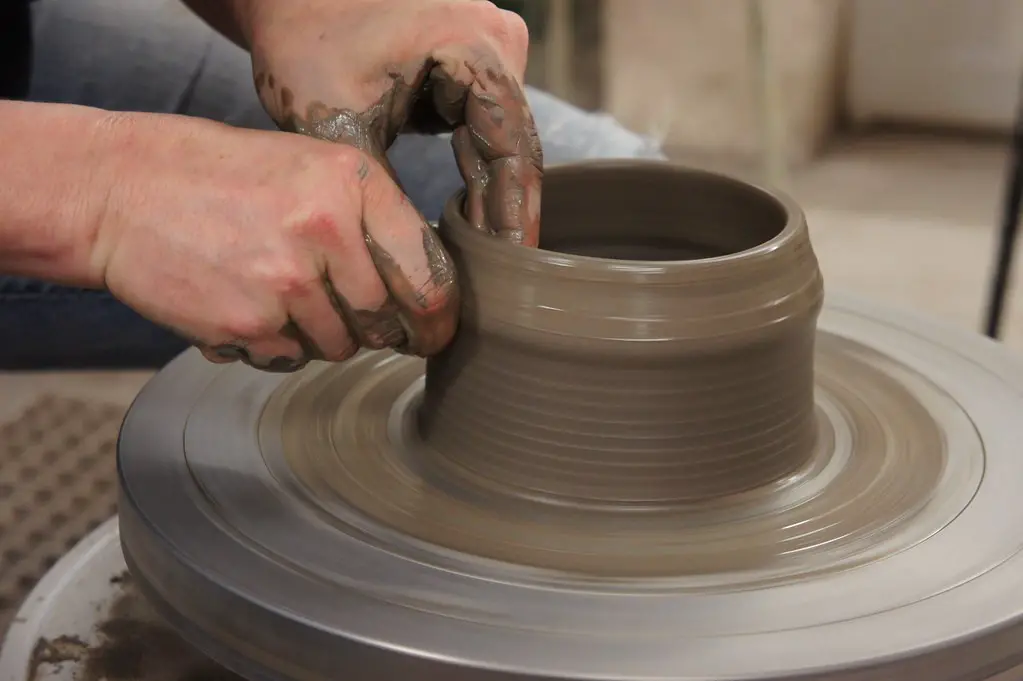

Did you just watch a video on pottery-making that got you inspired? So, where would you start? What clay should you choose to work with? If you are a beginner, the key is to opt for the easiest option, which is no doubt air-dry clay. But what would you make with it if you were just starting? Again, as a beginner, you would need something simple and easy to help you understand the basics of pottery making. In this blog, we will list out some easy yet fun air-dry clay projects to help you get started. So, without further ado, let us check it out!
Candlestick Holders
Candles tend to add a beautiful warm ambiance to your house. However, you simply cannot place them directly on a table or any corner of your home. In addition, the wax stains might be tough to get rid of. This is why candlestick holders tend to be a great choice. But why would you purchase them? Instead, you can make one at your home.
To create this, you can pick a candle that you have at home and craft your holder around it. First, start by rolling out your clay and then cut a round base with the help of a round cookie cutter. Next, using the rest of the clay, form a cylindrical shape around the candle and make sure the thickness is uniform all around. Once you are happy with the shape and size, make sure you place the cylindrical shape on the circular base. Then, using some slip or water, start by evenly merging the cylindrical shape with the base. Do not forget to score the area you are fusing. Finally, let it dry completely, and once it is ready, you can color it and use it as your candlestick holder.
Trinket Dish
It is easy to forget or lose your keys or daily-wear jewelry if you place it here and there. So, it is important to have a dedicated place where you can keep your keys or jewelry. A beautiful trinket dish won’t just add beauty to your home décor but also help you not lose things now and then. To create this trinket dish, start by rolling out your clay with the help of a clay roller.
Next, place a circular disc on the rolled-out clay and cut out the shape with the help of a pen knife. Once you have successfully removed any extra clay, start by gently elevating the edges to give it a bowl-like shape. But make sure you don’t elevate it a lot, just enough to give it that required shape.
Now, you can create texture on the clay while rolling it out or add one later on with the help of stencils. For the latter, simply mix your choice of paint with some baby powder. Next, place the stencil on the dish and gently dab the paint mixture on the stencil with the help of a sponge. Once you have covered the entire surface, let it dry, and you will have a beautiful trinket dish to use.
Clay Mushrooms For Décor
If you are looking for an easy project to decorate your flower pots, planters, or fairy gardens, colorful mushrooms are made out of air-dry clay. First, you would have to create the mushroom’s stem. To do this, first, roll out your clay into long cylindrical shapes. Next, cut it off into desired sizes depending on how many mushrooms you wish to make. Now, pick each of these cylindrical pieces and make its base a bit wider so that it doesn’t fall due to its heavy and wide top.
Next, you have to create the mushroom cap. To do so, you can choose to form a convex shape and place it gently on the tapered side of the cylindrical base. Then, fuse the base and mushroom cap with the help of some water. But before you do that, make sure to score the area to be connected with the help of a toothpick or scoring tool. You can use the Xiem Retractable Scoring Tool for this purpose. It features six sharp needles that aid with precision scoring. Moreover, it retracts when not being used to ensure safety.


Once you have successfully joined the two parts, let it dry out completely and then paint it in your favorite color.
Conclusion
Given how adaptable air-dry clay is, it is the best beginner-friendly clay choice available. To ensure you learn the basics of crafting with air-dry clay easily, these projects listed above are a perfect choice. However, make sure you keep the clay wet while working on different parts. To do that, you can place a damp towel on the clay you aren’t working with. This will give you a longer work time, especially as a beginner who is trying to figure out this versatile clay’s workability.