Plasters are a versatile product that is among the fan favorites of potters. From use in casting to mold-making and even crafting damp boxes, they can be used for a range of techniques depicting creativity. However, the types of plasters can differ, and each has its application. For beginner artists, it could be confusing to pick the right option for their pottery escapades. Among the options available in the market, plaster of Paris and pottery plaster can be particularly confusing.
Decoding the Differences: Plaster of Paris vs. Pottery Plaster
Simply put, pottery plaster tends to be harder as compared to plaster of Paris. The former is ideal for casting strong molds to prevent wear & tear. On the other hand, Plaster of Paris tends to be less expensive. It is ideal for items that have low wear & tear. However, depending on the brand, Plaster of Paris can be just as durable and strong as certain brands of pottery plasters.
Let us get in-depth on this topic to know more about the differences between the two.
How Do Plasters Work?
When learning pottery work, you will come across different plaster variants. Calcium sulfate is the prime ingredient present in most plaster variants which are somewhat similar to the ingredient present in chalk. This mineral is mined directly from the earth & then processed accordingly. The processes involved here include aspects such as grinding the mineral to its powdered form and then heating it.
This particular process of heating the mineral is termed calcining. As the mineral is heated up, calcium sulfate starts to lose some of the water that is present within. Partially dehydrated calcium sulfate is termed “hemihydrates”.
When partially dehydrated, this mineral becomes a usable ingredient in most plaster variants. When water is mixed with this mineral, a mixture-setting reaction occurs. In this chemical reaction, water combines with the particles of calcium sulfate. When this happens, calcium sulfate intricately bonds with water and transforms from its hemihydrates state to a dihydrate state.
During this setting reaction, one can observe crystal formation in the calcium sulfate and water mixture. These crystals help the plaster in its hardening process. These crystals tend to create a structure similar to a matrix which gives the plaster its strength. These crystals also create plaster capillaries. They are tiny and open microscopic channels that help add porosity to the hard plaster.
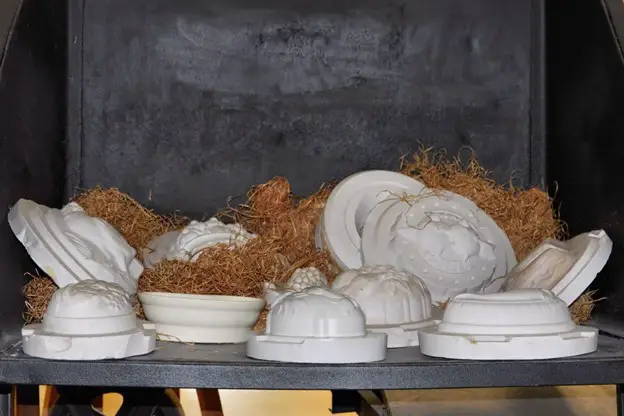
The prime reason plaster tends to be a handy option for pottery enthusiasts is the fact that it is absorbent and porous. When used in the form of a casting mold, slip or liquid clay can be poured within the mold created by the plaster. This helps harden the slip and transform liquid clay into the form of greenware pottery.
Different Variants of Plaster
Also known as gypsum, plasters tend to vary in terms of strength after being mixed with the set and water. The setting time also varies along with the absorbency factor. So, depending on all these factors, let us learn the differences between the Pottery Plaster and the Plaster of Paris.
Given that Plaster of Paris comes cheap, it is easily available for potters. So, let us learn more about it first.
Understanding Plaster of Paris
Simply put, Plaster of Paris tends to be an umbrella phrase that refers to several plaster variants. The name Plaster of Paris comes with historical origins. Given that the beautiful Paris city sits on a massive gypsum supply, hence, the name.
This plaster variant can broadly be categorized into 2 segments. They are termed alpha and beta gypsum. It denotes the way ingredients in the plaster are heated during the production process. When heated in a non-pressurized environment, gypsum converts to beta gypsum. These crystals tend to be shorter & less organized. On the other hand, gypsum heated in the pressurized atmosphere turns into alpha gypsum. It has an organized and longer crystal structure.
Plaster of Paris is said to be categorized as beta gypsum. This is because it is among the less durable gypsum variants. Several manufacturers create a blend of alpha and beta gypsum to create different products to increase the durability factor.
If you are looking for a good quality Plaster of Paris for your mold creation project, you can try out the Falling in Art Plaster of Paris. This safe & easy-to-use plaster is perfect for mask-making, diorama, and sculpture-making.
How is Plaster of Paris different from Pottery Plaster?
In terms of trade, Plaster of Paris often means the same as that of Pottery Plaster. In general, these terms can be used interchangeably, denoting the use of softer plaster meant for application in decorative molding.
However, in the pottery world, these two plaster variants are different in terms of properties.
Pottery Plaster: What is it?
Pottery Plaster features a strong composition making it rather strong in comparison to the Plaster of Paris. It is crafted from high-quality alpha gypsum. It means that this plaster variant is created from heated-up gypsum, which is semi-dehydrated with pressure applied during the production stage. Given that the crystals created in the alpha gypsum variant tend to be longer and more organized, it is stronger post-setting.
| Plaster of Paris | Pottery Plaster |
| Shorter and Less Organized Crystal Structure | Longer and More Organized Crystal Structure |
| Prone to Breaking (Weaker) | Stronger and Durable |
| Chips and Erodes Quickly | Withstands Eroding from Continual Usage |
| Ideal for Smaller Molds | Used for Jiggers & Jollys Plaster Molds |
| More Porous | Less Porous |
| Shorter Drying Time | Longer Drying Time |
Conclusion
Most potters would recommend the use of Plaster of Paris for items that are low in wear & tear kind. A great example of such items would be damp boxes. Once the box is lined up with plaster, it is protected & unlikely to crack or chip. Moreover, the Plaster of Paris tends to be cheaper compared to the Pottery Plaster. If you can make do with low strength, Plaster of Paris would be a good choice. On the other hand, Pottery Plaster fits best for jiggering, jollying, or slip casting. Plus, you would also get access to better durability. Ultimately, the choice comes down to what fits your project the best. If you are looking for a budget choice for small items, Plaster of Paris should be your go-to choice; otherwise, Potter Plaster is what you need!